
Scrum, XP, Management and the Ethics of Agile Software Development

FIRST LEGO League Robotics in Brooklyn

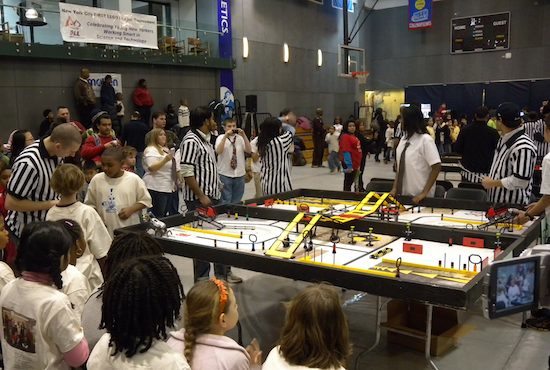
2010 FIRST LEGO League Qualifier Brooklyn
FIRST LEGO League (FLL) Robotics Tournament, Brooklyn Borough Qualifier.

FLL is a global program created to get children excited about science and technology. A hands-on program for ages 9 to 16 (9 to 14 in the U.S. and Canada), FLL uses Challenges based on real world scientific problems to engage children in research, problem solving, and engineering. The cornerstone of the program is its Core Values, which emphasize friendly sportsmanship, learning, and community involvement. (more…)

  • email
  • Print
  • Digg
  • Reddit
  • StumbleUpon
  • Google Bookmarks
  • del.icio.us
  • LinkedIn
  • Facebook
  • Twitter

iRobot’s Soft Morphing Blob ‘Bot Takes Its First Steps

From the IEEE Spectrum via YouTube:

iRobot’s soft, shape-shifting robot blob can roll around and change shape, and it will be able to squeeze through tiny cracks in a wall when the project is finished. Video presented at IEEE IROS 2009.

  • email
  • Print
  • Digg
  • Reddit
  • StumbleUpon
  • Google Bookmarks
  • del.icio.us
  • LinkedIn
  • Facebook
  • Twitter

On the Media – cruelty and vulnerability on the internet

Streams of two segments from the NPR show On the Media:

Smirch Engine

There’s a name for how cruel people can get given a little anonymity on the internet. It’s called “online disinhibition effect” and the resulting venom can ruin your day or worse, destroy your good name.

The Net’s Mid-Life Crisis

The basic architecture of the Internet hasn’t changed since it was conceived 40 years ago. But what was once the playground of wonks is now the main staging area for the global economy and open to an array of security vulnerabilities.

  • email
  • Print
  • Digg
  • Reddit
  • StumbleUpon
  • Google Bookmarks
  • del.icio.us
  • LinkedIn
  • Facebook
  • Twitter

ContactPoint – Protecting the Children

ContactPoint is a web accessible database containing identity information for all English children.

ContactPoint - Every Child MattersFrom the Department for Children, Schools and Families:

ContactPoint holds the following basic information for each child in England up until their 18th birthday:

  • name, address, gender, date of birth and a unique identifying number
  • name and contact details for each child’s parent or carer
  • contact details for services working with a child: as a minimum, educational settings such as schools and GP practices
  • contact details for other service providers where appropriate, for example health visitors or social workers; and whether practitioners are lead professionals and have undertaken assessments under the Common Assessment Framework (CAF). Please note these are not currently held on the system but will be added over time.

The new flow of information is intended to detect abuse and save children’s lives. According to the Financial Times:

It (ContactPoint) was first proposed after the 2003 Laming report into the death of Victoria Climbié, the eight-year-old girl who died after failures by social services.

Still the risks are alarming.

From the Times Online:

In March the Government admitted that it had uncovered problems in the system for shielding details of an estimated 55,000 vulnerable children. These include children who are victims of domestic violence, those in difficult adoptions or witness protection programmes and the children of the rich and famous, whose whereabouts may need to be kept secret.

However, there remain concerns about the security of the database, which was recently criticised by the Rowntree Trust as illegal under human rights and data protection laws.

Balancing the potential for benefit and harm can be incredibly difficult. Is the right answer obvious to you?

  • email
  • Print
  • Digg
  • Reddit
  • StumbleUpon
  • Google Bookmarks
  • del.icio.us
  • LinkedIn
  • Facebook
  • Twitter

Automagic content aggregation

From Huffington Post, Washington Times Runs Obama Girls’ Photo With Story About Murdered Chicago Kids

Editor John Solomon told Greg Sargent technology, not a person, was to blame.

“The theme engine, through automation, grabbed a photo it thought was relevant, and attached it to the story,” Solomon said, acknowledging that the photo had gone up without a person seeing it. “There was no editorial decision to run it. As soon as it was brought to our attention, we pulled it down.”

“There was no editorial decision to run it”??

Who decided to acquire/build a search algorithm to publish file photos without human oversight?

The example is outrageous but using loose tags to associate photos of people to stories of crime and human tragedy? Under what circumstances does this technical solution make journalistic sense?

Technology to blame? Not even the technologists. Doesn’t this newspaper have an editorial board?

How about applying the same standard of care to your online property that you’d use for print?

Mistakes happen but blaming your tools just betrays how unequipped you are to use them.

  • email
  • Print
  • Digg
  • Reddit
  • StumbleUpon
  • Google Bookmarks
  • del.icio.us
  • LinkedIn
  • Facebook
  • Twitter

Technological fiasco enablement

From Gothamist, “NYU Accidentally Makes Fools Out of 489 Prospectives

NYU sent an email to nearly 500 students this week that they should pack their bags and get ready to make their way over to Greenwich Village this fall as members of Wagner School’s next graduate class. An hour later, the school sent another email telling those same students to scratch that—they were actually rejected.

  • email
  • Print
  • Digg
  • Reddit
  • StumbleUpon
  • Google Bookmarks
  • del.icio.us
  • LinkedIn
  • Facebook
  • Twitter

GhostNet

From the New York Times article, Vast Spy System Loots Computers in 103 Countries, by John Markoff

Intelligence analysts say many governments, including those of China, Russia and the United States, and other parties use sophisticated computer programs to covertly gather information.

The electronic spy game has had at least some real-world impact, they said. For example, they said, after an e-mail invitation was sent by the Dalai Lama’s office to a foreign diplomat, the Chinese government made a call to the diplomat discouraging a visit. And a woman working for a group making Internet contacts between Tibetan exiles and Chinese citizens was stopped by Chinese intelligence officers on her way back to Tibet, shown transcripts of her online conversations and warned to stop her political activities.

  • email
  • Print
  • Digg
  • Reddit
  • StumbleUpon
  • Google Bookmarks
  • del.icio.us
  • LinkedIn
  • Facebook
  • Twitter

Color e-ink reader

From Endgadget Japan as pleasingly broken translated by Google the Fujitsu FLEPia. 1.8 second refresh rate at 64 colors and pricey. But the first portable computers and cellphones threw out your back.

It’s a start.

  • email
  • Print
  • Digg
  • Reddit
  • StumbleUpon
  • Google Bookmarks
  • del.icio.us
  • LinkedIn
  • Facebook
  • Twitter

21st century scroll

A rollable E-ink plastic display…

Now make the wrapper less obtrusive, the display larger and touch sensitive.

readius

  • email
  • Print
  • Digg
  • Reddit
  • StumbleUpon
  • Google Bookmarks
  • del.icio.us
  • LinkedIn
  • Facebook
  • Twitter

Plastic e-paper

From Engadgit, A lightweight, large e-reader using a plastic lcd display.

Plastic Logic’s targeting the business market is an interesting idea. It worked for Blackberry before iPhone cracked the consumer market.

I want color e-paper and the ability to roll or fold the display. Come on, that would be cool.

  • email
  • Print
  • Digg
  • Reddit
  • StumbleUpon
  • Google Bookmarks
  • del.icio.us
  • LinkedIn
  • Facebook
  • Twitter