Power, dissent, and bullying in software developer communities
Grassroots developer communities form around shared values in dissent against institutions and norms that dehumanize their work and diminish their efforts. They attack these orthodoxies with humor, heretical thinking, and hard work.
This benefits society when developers defy those with greater power. It harms society when developers bully people with less power.
At the ThoughtWorks sponsored Agile East, Martin Fowler spoke to his post, SmutOnRails.
Part of the community was offended by a presentation at the GoGaRuCo (Golden Gate Ruby Conference). Others fought back saying that no offense was meant, the presenter apologized, and that the tone was in the spirit of the Rails community.
(T)he view of the rails leadership seems to be this: that the objections to the presentation are yet another attempt to foist empty corporate values on the thriving Rails ecosystem… (more)
This debate is not unique to the Rails community. It reminds me of concerns my friend, Luke Melia, raised over jokes and behavior at the first Austin Alt.NET. Martin Fowler links off to a similar controversy in the Flash community.
It is also not unique to developer communities but developers in particular need to be concerned about the outcome.
Women, African Americans and Hispanics are under-represented in IT and even more so in software development. In 2001-2002 74.4% of software developers were men. 78% of those men were white.
In 1986 the percentage of women in CS programs peaked at 37%. The percentage of women in computer science programs has gone down since then.
In 2001-2, only 28 percent of all undergraduate degrees in computer science went to women. By 2004-5, the number had declined to only 22 percent. — What Has Driven Women Out of Computer Science?, NY Times
There were 15,000 women in CS progreams in 1986. Riding natural cycles this number was not matched again until 2003. This latter number contains a higher percentage of non-resident aliens who will not necessarily contribute to the US workforce.
This despite higher percentages and numbers of women acquiring college educations than men. In 2007, 33% of women 25-29 held a four year degree or higher versus 26% of men. 55% of graduates with four year degrees or higher aged 25-29 were women.
Women are even receiving the majority of degrees in science and technology. They have shown steady progress in biology, chemistry, physics, mathematics and engineering.
Metrics can be misinterpreted but these quantitative measures support a stunningly obvious anecdotal observation. US software developers are a white male enclave.
This is a power imbalance and we developers are part of the problem.
Isolation is a key factor for a higher attrition rate among women and minorities, said Teresa Dahlberg, director of the Diversity in Information Technology Institute at UNC Charlotte. People tend to associate with “like communities,” where people have similar backgrounds and interests, she explained. — Computer science lacks women, minorities, SD Times
So when we behave in a way that marginalizes and intimidates talented women and minorities, we abuse power. We become bullies. We are oppressors.
“There is a good amount of research that shows that women are judged more harshly than men, for hiring, evaluations and promotions,” she added. “Virginia Valian [author of "Why So Slow? The Advancement of Women"] shows this for women in science, technology, engineering and math faculty jobs.” Virginia Valian is a professor at Hunter College. — SD Times
Part of the problem may be a perception that software development doesn’t contribute enough to society. To the degree this perception is true it is damning. To the degree it is just a perception we have work to do as advocates.
Our actions need to be judged not by our intentions but by the outcome.
Requisite variety within our teams remains an essential enabling condition for sustained innovation.
Access to technology is growing across all tiers of class, race and gender both in the US and overseas. Diverse teams can better address our market and build software better adapted to our end users.
A more diverse workforce provides the kind of social change that will help us create a more humane workplace for developers.
Finally, anything that limits the number of able US software developers hurts our ability to compete.
When developer communities marginalize women and minorities, we conspire to isolate ourselves from the larger society. We defeat our own attempts to change the power structures around us and improve our lot and our output.
Short link: http://jkat.me/7kfHtY
Working on a paper about women in software development
I just submitted a paper on agile values and the underrepresentation of women in software development.
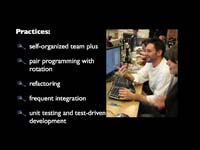
This is not an original topic but the research I’ve read has focused on how women who participate in agile practices, particularly XP pair programming have more favorable impressions of the work and of their ability to contribute both of which are correlated to entering the occupation.1,2
My belief is that agile practices are tools but it is the agile values that give us the urgency, courage and insight to wield those tools towards a desired outcome.
That is, we are much more capable of making software development more tolerant and inviting of diversity if we believe we should do this as part of our core mission as Agilists to develop with craft and quality and to deliver value to our employers and our end users (do not forget).
So, the rough outline of my paper is this:
- The shortage of women entering software development and disproportionate share of women leaving mid-career is real and measurable and well documented.
- The problem is worse in IT than it is in almost all other areas of STEM because, unusually, the percentage of women in software development has actually declined over the last 20 years.
- This shortage and particularly the attrition of experienced women developers represents a material burden to our industry.
- Product teams that represent the diversity of their customers have a potential advantage in developing products that appeal to that diverse customer base
- Women are at least the equals of men when it comes to influencing consumer technology spending and online activity
- Therefore, it is in the interest of the industry to educate, recruit and retain women developers
- Agile is a collection of practices united by a coherent set of principles
- As agile becomes mainstream it is more important than ever that practitioners understand and embody these principles
- The creators of the Agile Manifesto realize this and are calling us to a principled approach to our work
- These principles are at stake when it comes to things that affect the competitiveness, insight into end users, and potential for innovation in our teams
- If we engage our agile practices behind this principled cause we can begin to remove the impediments within our own organizations to the recruitment and retention of women
- When we do, we will influence larger changes across the industry, within education and in society
I’ll go into more detail and try to defend my arguments in later posts. In the meantime, I’m happy to engage with anyone who finds fault in my premise.
1S. Berenson and K. Slaten. “Voices of women in a software engineering course” in JERIC, vol. 4.1, Mar. 2004.
2O. Hazzan and Y. Dubinsky. “Empower Gender Diversity with Agile Software Development” in Encyclopedia of Gender and Information Technology. E. Taugh, Ed. Hershey, PA: IGI-Global, 2006, pp 249-256.
Short link: http://jkat.me/jZqQpF
Are we driving women away from software development?
These are notes from my presentation at the Hawaii International Conference on System Sciences (HICSS) #45 on Agile values, product innovation and the shortage of women software developers.
I’ve broken the fifty slide, eighteen minute presentation into several posts.
This first part uses existing research to establish:
- women are under-represented in software development,
- this is a multi-decade trend atypical of Science, Technology, Engineering and Math (STEM),
- women are leaving mid-career in disproportionate numbers and
- young women are opting out as early as middle and high school.
I’ll link to my full paper when it is available and to subsequent posts as I publish them.
There is an abundance of research on the problems women face in our field. I would love real researchers to jump in on whether Agile principles and Agile practioners can really make a difference here.
I’d also love any suggestions of organizations, institutions and individuals I might reach out to for more information, collaboration, or to take up the cause.
Next: Are women are under-served by software…
The full citation list for my paper.
Short link: http://jkat.me/xzOjX7
Are women are under-served by software?
These are notes from my presentation at the Hawaii International Conference on System Sciences (HICSS) #45.
I’ll link to my full paper when it is available and to subsequent posts as I publish them.
Agile values, product innovation and the shortage of women software developers Part 2 of 7
Next: Can women devs help software better address the needs of women end users…
Previous: Are we driving women away from software development?
There is abundant research on the problems women face in our field. I would love researchers to jump in on whether Agile principles and Agile practioners can really make a difference.
I’d also love any suggestions of organizations, institutions and individuals I might reach out to for more information, collaboration, or to take up the cause.
Please comment on my proposal to Agile 2012.
The full citation list for my paper.
Short link: http://jkat.me/zb85T3
Can women devs help software better address the needs of women end users?
These are notes from my presentation at the Hawaii International Conference on System Sciences (HICSS) #45.
I’ll link to my full paper when it is available and to subsequent posts as I publish them.
Agile values, product innovation and the shortage of women software developers Part 3 of 7
Next: Do Agile principles demand we confront the shortage of women developers…
Previous: Are women are under-served by software?
There is abundant research on the problems women face in our field. I would love researchers to jump in on whether Agile principles and Agile practioners can really make a difference.
I’d also love any suggestions of organizations, institutions and individuals I might reach out to for more information, collaboration, or to take up the cause.
Please comment on my proposal to Agile 2012.
The full citation list for my paper.

Short link: http://jkat.me/yyWLrM