
About Ken Judy

I am an executive leader, software developer, father and husband trying to do more good than harm. I am an agile practitioner. I say this fully aware I say nothing. Sold as a tool to solve problems, agile is more a set of principles that encourage us to confront problems. Broad adoption of the jargon has not resulted in wide embrace of these principles. I strive to create material and human good by respecting co-workers, telling truth to employers, improving my skills, and caring for the people affected by the software I help build.

Low Traction Subtraction

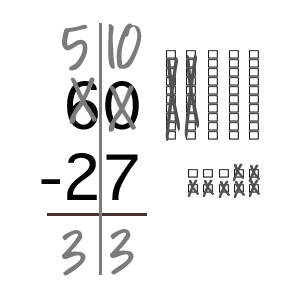
Subtraction using Everyday MathThis is what a solved subtraction problem looks like using the technique my second grader is learning.

At first she was drawing all sixty squares. I talked her into drawing tens as long rectangles.

A page of homework is 20 problems. Each problem takes 3-5 minutes. She also has writing and reading.

To fight the tedium, we used legos one day and a whiteboard another.

But the teacher likes to see the written squares to confirm the kids understand. So while making things physical makes it more fun it only adds time.

I know she’s drifting when she starts climbing the table or erases mistakes until the paper rips.

Any constructive advice?

Ethical Dilemmas and Agile Software Development

“Doc” List and I proposed an ethics open space for Agile 2008.

We all experience pressure to compromise our work and our reasonable care for others. As software becomes more beneficial, more pervasive, and inter-connected, our potential to harm grows.

Agile practices are making a contribution to ethical practice in our field, but we can and should be doing more to help each other navigate the ethical dilemmas we face.

This session will attempt to frame professional ethics in the context of agile values, make the community aware of the regulatory environment we may face from both state governments and standards bodies, and engage the participants in a conversation about how our day-to-day actions affect our employers, customers, peers, end users, and society.

Here’s the proposal http://submissions.agile2008.org/node/1573. Please rate and comment!

The Functional Manager in Agile

Home Farm by Hellsgeriatric, on flickrTeam managers should till the soil with their teams.

Anything else is waste and waste must be rooted out.

Still it is hard.

Luke Melia wrote about how he performed as functional manager and dedicated 75% of his time pairing.

There are two tremendous challenges with this.

The first is limiting distractions in order to remain a reliable contributor.

Luke has tremendous reserves of focus and enthusiasm. As his manager, I did everything I could with our scrum master, Salim Divakaran, to support him, remove distractions and share workload.

The second challenge is being both the boss and a peer.

Luke recruited most of the team, he held weekly one on ones with each person, he insisted on unvarnished feedback, and is worthy of respect as both a peer and a manager.

So, here is the pattern: An experienced coach with people skills and authority over development practices pairing in with the developers. An experienced scrum master. Functional management residing in one or the other or divided up in some sensible and easily described way among the two of them.

This enables direct participation in the work, management attention to the team, and strategic contribution to the rest of the company.

Unintended Consequences

Green on the Empire State Building by paulaloe, on flickrFrom the NY Daily News via the Gothamist. Claims there’s a car dead zone around the Empire State Building.

…people suspect that it’s the presence of the multitude of radio and tv transmitters on the building’s 203-foot spire …jamming key-less locking systems and automotive disabling security systems.

Interactions among hard and soft technologies having an unintended effect on people — or bullshit.

Urban Legend In The Making: The ESB Dead Zone

Being Good

“…there are countless small, unpretentious things we know with complete certainty.

Happiness is preferable to misery, and dignity is better than humiliation. It is bad that people suffer, and worse if a culture turns a blind eye to their suffering. Death is worse than life…

the attempt to find a common point of view is better than manipulative contempt for it.”

– Simon Blackburn, Being Good: A Short Introduction to Ethics