About Ken Judy

I am an executive leader, software developer, father and husband trying to do more good than harm. I am an agile practitioner. I say this fully aware I say nothing. Sold as a tool to solve problems, agile is more a set of principles that encourage us to confront problems. Broad adoption of the jargon has not resulted in wide embrace of these principles. I strive to create material and human good by respecting co-workers, telling truth to employers, improving my skills, and caring for the people affected by the software I help build.

Design Levers in Collaborative Systems

Bronze Roughneck by takomabibelot on flickrAt HICSS-41, I heard a talk by Dr. Yochai Benkler on cooperation in human systems.

One aspect of his talk was design levers that influence how well a group of people cooperate.

As intrinsic motivators, Dr. Benkler listed: humanization, trust, fairness and solidarity. Extrinsic motivators were punishment, reward and transparency.

  • Humanization occurs when participants see others as real people with feelings, strengths and weaknesses, connection to others and history.
  • People are more likely to trust when they are themselves trusted prior to earning it. Trust requires risk. If nothing is at stake there is no need for trust. Dr. Benkler pointed to sociology studies that show when you reduce the need for trust you actually reduce trust.
  • A perception of fairness is closely tied to our reading of others intentions as much as outcomes.
  • Solidarity is cohesion and a sense of belonging. It’s bolstered when a group is self-governing and can be strengthened or weakened by an external threat.
  • Reward, punishment and transparency have complex and unpredictable effects on intrinsic motivators. Even correctly applied within a given cultural and group context, they may crowd out trust and solidarity as well as having mixed effects on human connection and perceived fairness of the system.

Managing collaborative groups requires iteratively inspecting and adapting.
[agile] or Else

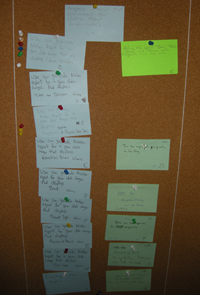
Cork Board by kjudyJeff Sutherland said he was finding more developers who will only work in agile software development teams.

He also said that to his estimation about 10% of shops that claim to be practicing Scrum pass the Nokia test and have self-organized teams, product backlogs prioritized by a product owner and estimated by developers.

And that doesn’t even speak to refactoring, test driven development, pairing, continuous integration, built in quality, acceptance testing, etc.

And that doesn’t speak to knowledge creation and sharing practices across the entire organization, clarity of vision, understanding competitors, collaborating with customers, continuous improvement, and embrace of change.

I’ve come to understand that agile values place demands on development, management and business practices.

Two questions arise from this:

  • Would you only work in an [agile] shop?
  • What do you mean by [agile]?

for [agile] feel free to substitute: Lean, XP, Scrum, XP/Scrum, Crystal, Adaptive, etc. etc.

From Best To Worst

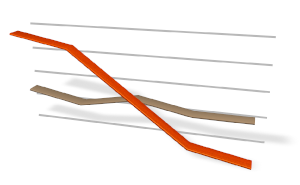
Performance GraphManagement structures are often designed to avoid failure. An unintended consequence is undermining top performers.

Marcus Buckingham describes this in First, Break All the Rules based on Gallup Research across a range of professions.

…in numerous job functions the best and the worst performers shared some, but not all, traits. Both the best and the worst salespeople have call reluctance; the mediocre performers did not. Both the best and the worst nurses had a personal connection with their patients; mediocre nurses stayed aloof. What was important is what the top performers did about this strong emotional link; they used it to empower and motivate them. The poor performers used it to shrink from effective action. Those with no emotional attachment lacked the motivation to excel.

Hospitals rotate shifts so that nurses cannot form personal attachments to patients. Prevents poor performing nurses from burning out. Doesn’t impact mediocre nurses who don’t engage anyway. Prevents the best nurses from giving the kind of care that improves patient outcomes.

Compulsory testing and centralized lesson plans are designed to ensure poor teachers raise poor student performance but makes it much harder for great teachers to innovate and personalize instruction and bores precocious students ready to go beyond core instruction.

If the core difference between poor and excellent performers is that the best are motivated and empowered by their emotional engagement to their work, then it follows if you demotivate and disempower your best performers you remove the distinction.

Under a poor leader, the exceptional will under-perform the mediocre.