About Ken Judy

I am an executive leader, software developer, father and husband trying to do more good than harm. I am an agile practitioner. I say this fully aware I say nothing. Sold as a tool to solve problems, agile is more a set of principles that encourage us to confront problems. Broad adoption of the jargon has not resulted in wide embrace of these principles. I strive to create material and human good by respecting co-workers, telling truth to employers, improving my skills, and caring for the people affected by the software I help build.

Microsoft Surface

Yesterday, I got to sit in while members of Microsoft’s Surface™ team showed my CEO, Gerry Laybourne, a working demo.

Microsoft Surface&tradeI’m a convert. The interface relies on organic human gesture and, more importantly, encourages eye contact and collaboration. Truly beautiful. And the simpler they make it the more emotional and purposeful it will be.

I realize there are similar systems out there but Microsoft’s hardware implementation is novel and potentially more powerful than other multi-touch displays.

Watching Gerry interact with the surface team, I was reminded why she is such a force for invention and creativity. She has an expert’s blink response to new ideas. Her feedback was immediate and unexpected in the best sense. As a Surface™ team member said, “it feels like we’re learning more from you than you are from us.”

Agile Anti-Pattern: Frankenstein Project Planning

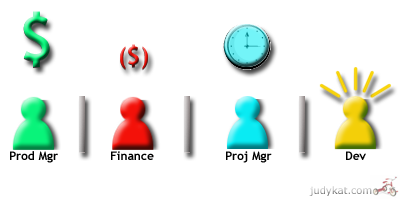
AntiPattern Separation of Concerns in Product Planning by kjudy

Separation of Concerns is a classic software design consideration but in this anti-pattern, management takes a coherent concern (i.e. what opportunity does a potential software project represent), breaks it apart and tasks the pieces out to siloed business units.

One group creates revenue models to meet to top line goals, another group models costs as fixed budgets, yet other groups devise features and schedules. All without engaged participation by the developers who will be asked to implement.

Each actor has strong motivations to push one agenda (high revenues, low costs, aggressive schedules, ambitious feature lists) without offsetting responsibility for other concerns. The result is impossible project expectations.

Finally these separate models are patched together into a PowerPoint presentation and called a “plan”. “It’s alive! It’s alive!”

Related anti-pattern: the Anemic Management Matrix.

Team

At Oxygen, we have a team. Knot

Building this team has been the collaborative work of years.

Our CTO, Steve, made IT a strategic asset and championed a seat at the table for software development. I introduced agile principles, carved out space for agile development practices and built a product team.

Our dev director, Luke, and coach, Kris, built a disciplined XP practice. Our product team, Ilio and Suzann, and our Scrum master, Salim, built our Scrum practice.

With Luke’s lead, the team built itself by adding exceptional talents and engaging human beings. Wendy, Oksana, Lee, Robert, Daniel and our first UX Designer, Bob. Each brings experiences, specialties, passions and humor that spurs creativity in our products and simplicity, quality, and expressiveness in their underlying implementation.

For the last year, our team has included our CEO, Gerry, an inspiring and audacious product owner.

Over almost eight years together, the core of us struggled through bad practices and mediocre projects. We taught ourselves better methods and brought in great talent providing the best fit. We grew, we availed ourselves of experienced coaches, we matured, we hit our stride. Now we contribute to our field through open code, writing, presentations and mentoring.

This team is a competitive advantage. We share values, practices, and history. We have complimentary strengths, camaraderie and spirit. We are inventive, versatile and fast on our feet. Our dedication to each other is our strongest retention and recruiting tool.

I care for these individuals and I love the team we’ve created.

The Oxygen Team

Agile Anti-Pattern: The Inverted Org

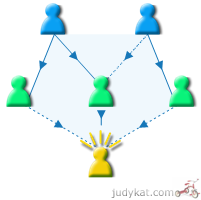
Inverted Org by kjudyA chain of direct and “dotted line” reporting that makes a worker accountable to many managers with no clear boss.

A near total separation of authority and responsibility. The worker is always at fault but overworked and excused. The communication overhead justifies creating more managers.

Related Anti-Pattern: Value Stream Backwash where analysts specify more projects than workers have capacity to deliver. Again, often solved with more analysts.