About Ken Judy

I am an executive leader, software developer, father and husband trying to do more good than harm. I am an agile practitioner. I say this fully aware I say nothing. Sold as a tool to solve problems, agile is more a set of principles that encourage us to confront problems. Broad adoption of the jargon has not resulted in wide embrace of these principles. I strive to create material and human good by respecting co-workers, telling truth to employers, improving my skills, and caring for the people affected by the software I help build.

The Road Not Taken

Mountain Path Ript - Photo by Kathie Horejsi

I began advocating agile principles at my company four years ago. Over time, my co-workers and I have grown into a Scrum/XP team. We have a track record of successful projects and a handful of supportive sponsors. Senior executives value our developers. My CTO understands the team dynamic itself is the prize asset.

Having reached a milestone on one of our larger projects and seeing ambitious work ahead, I wanted to write about how I stood at a crossroads: contribute to the team or attempt to nurture agile values elsewhere in the organization.

It’s a pleasant, contrasting choice. But it assumes a lone agile team can thrive after becoming visible to the larger organization. There are two pressing reasons why I doubt this is true:

  • An agile team attacks impediments from within or without. Either the team makes progress against these obstacles or it declines.
  • Human nature abhors exceptions however exceptional. If the organization doesn’t become a little more like us, it will surely, inevitably re-make us to be more like it.

Mountain Path Ript - Photo by Kathie Horejsi

So, no crossroads. One path lies before me and it looks surprisingly familiar.

As I did four years ago, I must advocate agile from within and peer to peer. This time around, I have success at my back but face longer odds.

Scrum the project. Scrum organizational change.

I can only make progress one step at a time. I must demystify what we do by allowing more chickens into my team’s reviews. I must find and coach others predisposed to agile values. I must find at least one executive willing to scrum a thorny project with their staff. If I get the chance, I must seek out expert coaching for those above and across me in the organization.

As four years ago, success relies more on others than on myself. But I believe, as before, that not trying is worse than failing in the attempt.

The Beauty of Team

Our team just beta-released our first consumer product. Along the way, they accomplished something of more strategic value. They matured into a performing, self-directed team.

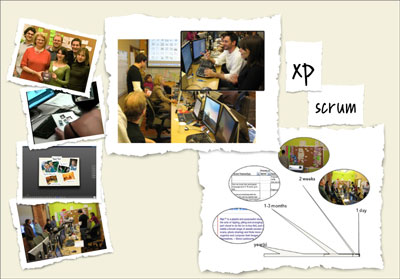
The Team Ript Page

A decent manager encourages software developers to do their best work while allowing them full personal lives. The heart of this effort is fostering strong teams. Individuals have bad days, make mistakes, lose momentum. A team watches each other’s backs, challenges each other, teaches each other. They build upon each other’s creativity.

The beauty part for a manager is — if you create the right conditions, start with the right people, trust them and hold them accountable — the team does the hard work of becoming. They deserve full credit for their achievements including the most ambitious achievement which is themselves.

That doesn’t mean it’s easy. Getting this consumer product to the general public has taken fifteen months. From our first study of agile principles to our current practice has taken the better part of four years of continuous improvement.

A Gen-Y Mating Dance

Weekend subway. Construction — attraction — sparks conversation.

Photo by Erik K Veland

He doth bestride the narrow aisle a colossus. Pin-striped. Pointy-toed. Erect arm grasping the pole.

She drapes the door. Flowing hair. Flowing blouse. Travel weary. At ease. Rolling bag between her and him.

Topics rise and fall under wheel on rail: her job, his stop, her yoga, his workout.

My wife and I try not to try to listen.

Yet the banal, unlikely choreography grips us like watching two astronauts brush their teeth in space.

“I could kick my leg as high as your head one or two times with no problem. After the third or fourth time, I might pull a hamstring or something.”

Women & Agile Development

Ken Schwaber made an audacious comment today. To paraphrase:

“One of my canaries in the coal mine is the number of women in the software industry. Women are smarter than men. They tend to gravitate to careers where they are compensated well and find the work rewarding. They are fleeing the our industry in droves.”

He was speaking at Agile 2007 on The Enterprise and Scrum.

The Stanford Daily reported that “13 percent of CS undergraduates are female this year, down from 24 percent in the 1999-2000 school year.” This despite National Science Foundation statistics that show more women are receiving bachelors degrees than men.

I agree with Mr. Schwaber, a software industry more inviting to women entering the workforce would provide a better, more humane environment for all employees.

Also, what potential innovation is being lost? History is rife with examples of gender inequality in service and outcomes across a wide variety of industries — most troubling being medicine. A male dominated field should not be confident it is best serving its women consumers.

My company’s own research indicates that women are men’s peers when it comes to the use, ownership and purchasing decisions around technology. So this is an opportunity as much as it is a concern.

A 2006 paper by McDowell, Werner, Bullock and Fernald found that pair programming practice “may help increase female representation in the field.”

Agile values and practices support a collaborative, empowering and sustainable work place. As practitioners, we should encourage research on whether this can contribute to a more diverse workforce.

Fundamentally, we have to make software development more conducive to the contributions of half our population.