About Ken Judy

I am an executive leader, software developer, father and husband trying to do more good than harm. I am an agile practitioner. I say this fully aware I say nothing. Sold as a tool to solve problems, agile is more a set of principles that encourage us to confront problems. Broad adoption of the jargon has not resulted in wide embrace of these principles. I strive to create material and human good by respecting co-workers, telling truth to employers, improving my skills, and caring for the people affected by the software I help build.

A Long Road Back

Not counting a PowerCenter clone, the last Apple computer I bought for myself ran OS 7.1 and looked like this… Google Image Search PowerBook 140

Ten years later, I’m having a wee of a time setting up my new MacBook Pro.

Why a decade between Macs? Don’t promise Copland and deliver System 7.5. Remember “Conflict Catcher”? All water under the bridge.

Today, ironically, was about Windows. I created a Boot Camp partition running Windows Vista with full Aero. A great environment to demo Ript. I can also use VM Ware Fusion to run that partition as a virtual machine within OS X.

MacBook Pro on Chair

Leadership, Circumstances, Styles of Play

John Maeda has another post on leadership.

“In movies we often see two scenarios: 1) the leader is surrounded by her soldiers as a wall of protection; or 2) the leader is the one that is the first to rush into battle.”

I have trouble with war metaphors in a time of war but I get that success is built upon both protecting potential and creating it.

This sentiment reminds me of Garry Kasparov’s description of his chess play, attacking, aggressive, “where the player who makes the first mistake loses” versus a maneuvering, defensive style that “accumulates small advantages over time.”

I have played the latter, quiet game, advancing through various roles and towards an agile organization over years.

Still more chess pieces by andrew_mrt1976'sMy game was winning over peers, demonstrating success, removing many obstacles and flowing past others, educating executives as they became receptive to it, and, above all, showing by doing — proving value on our terms by delivering value.

But as Mr. Kasparov points out, circumstances may require us to adopt alternative styles and I am clearly in that situation now.

My company may soon be integrated into a larger one. In that larger organization, I have met conscientious, competent people. If the acquisition goes through, they will work to realize as much benefit as possible while managing risks and minimizing harm.

However, drastic change will need to happen in a short time and there are three very different cultures at play: that of our team, our current employer and our prospective new one.

Time is a factor in another way as well. My team cannot endure setting the clock back on our product and software development practices. Agile development means little unless it is in partnership with an agile business. We don’t want to just build things well. We need to invent, serve users and win in the marketplace. We need it all.

If circumstances call for a more pressing style of play. So be it.

Story Card Hell

I was recently asked the following question:

“I’ve been dropped into a situation best described as “story card hell.” How do I reduce complexity of the software project planning without losing features?”

The project was to replace an existing system. The behavior was largely known. As a result, the initial planning generated enough cards to feel like, “way too much detail up front.”

My answer:

Don’t lose the work you’ve done but don’t place more value in it than it has.

Step back to think of the application as a phased set of releases. Talk with the team and product owner about a way of delivering the system in meaningful pieces that customers could (and hopefully will) use. Get creative with defining those steps as long as they lead you down a path towards your ultimate goal.

Once you have that road map. Do an exercise with the team to group your existing stories into those releases. There will be a natural tendency to add and change stories. That’s fine but don’t get too distracted by it. The main point is to get a sense of the relative size of the releases and move the bulk of the stories out of your immediate planning concern.

Now focus on the first release. Spend more time on those stories but still not with the scrutiny of an iteration plan. Make/allow the team to live with ambiguity. Set up an agreed upon rule of thumb for how much bigger a “theme” is from a real “story” and let the team know it’s okay to discuss these things at the “theme” level.

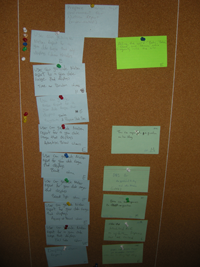
Story Cards

Then prioritize your release backlog. Have the team chunk the remaining vague stories/themes into future iterations for that release. This is your release plan. Expect it to change. Again, you’re getting a rough sense of how many iterations in the first release and moving later stories out of your immediate concern.

Now you can focus in detail on the stories for the next one or two iterations without getting drowned in details. Don’t be surprised if future stories become irrelevant or drastically change as you get to the iteration within which they fall. It’s okay.

My answer was based on what we’ve tried to do at Oxygen with coaching on release planning from Hubert Smits.

Here’s the full thread off LinkedIn.